
Ways to manage Risk
Now we've looked at the main types of risk to keep an eye on, we can concentrate on how to manage those risks.
Always be aware of the downside
Before you place every trade you should calculate exactly how much you stand to lose in the worst case scenario. Remember that sometimes the market can move quickly or gap, meaning you might not be able to get out of your trade at the level you wanted to.
You need to keep the worst case scenario in mind, because if there's a major market event, you may be overly exposed. This is particularly important to remember when placing leveraged trades, where your losses could be greater than your deposit.
Avoid emotional trading
When making trading decisions, you should distinguish between those which are rational and those which are emotional. Relying on 'gut' feeling will almost certainly end in disaster, so it's vital to back up your decisions with clear analysis. As we've seen earlier, creating a structured trading plan can help you manage emotional risk by providing clear guidelines and helping you maintain your discipline.
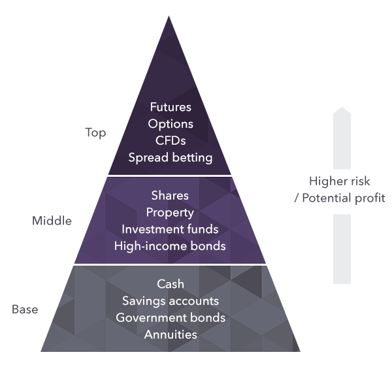
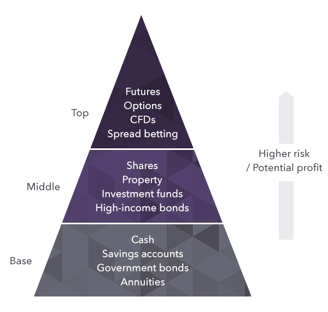
Most traders will probably want to keep the bulk of their investments in safe assets that provide regular, if unspectacular, returns. These are represented by the pyramid's base.
In the middle there are medium-risk assets, which should provide a stable return and also have the potential to appreciate.
At the top are the higher-risk investments which have the potential for huge returns but large losses too. The money you put into these high-risk assets should only be money that you can afford to lose without serious financial repercussions.
Of course, the pyramid acts as a guide rather than a set of rules, so you'll need to think carefully about the amount of time and money you have to invest, and the level of return you want to achieve when choosing which assets to trade.
Diversify
If you often have more than one position open at any one time, you can help minimise risk by putting your money into a broad range of different investments – in other words, not putting all your eggs in one basket.
For example, if you put all your investment capital into the shares of a single company, you risk losing it all if that company goes bust. On the other hand, if you buy shares in many different companies, your loss from the one that fails won't have such a devastating effect on your overall investment.
However, even spreading your capital across a range of different shares can't protect you from systemic risk factors that can affect the stock market as a whole.
Therefore the best way to diversify is to spread your investment across asset classes. For example, you may end up having a portfolio made up of shares, commodities, property, bonds and other investments. These markets often move independently of each other, providing protection against one particular asset class underperforming.
Select riskier investments carefully
If you do end up having a portfolio of different investments, it's sensible to balance out any particularly risky trades with more stable assets. The investment risk pyramid is a handy model to help you decide how to spread your risk across various financial instruments.
Calculate your maximum risk per trade
Choosing how much to risk per trade is all about your personal circumstances. You'll find some guidance that says don't risk more than 1% of your trading capital per trade, while others say it's ok to go up to 10%. Most traders agree not to go much higher than that though, and here's why...
If you go on a big losing streak, the amount you're risking per trade will have a huge effect on your capital and the ability to claw back your losses. Say you've got $10,000 of trading capital and you're unlucky enough to lose 15 trades in a row. Here's the difference between risking 2%, 5% or 10% per trade:
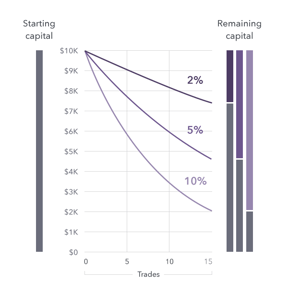
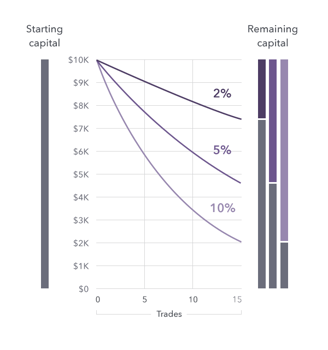
With 2% risk per trade, even after 15 losses you've lost less than 25% of your trading capital. It's conceivable that you can win this money back.
However, if you'd gone for 5% risk per trade, you'd have lost over half your initial trading capital. You'd have to more than double this amount to get to your original level.
With 10% risk per trade, things are even worse. You'd be down over 75% making it extremely difficult to make back the money you've lost.
The reduction of capital after a series of losing trades is called a drawdown. It's important to work out what percentage drawdown will make it difficult to reach your trading goals, and then ensure your maximum risk per trade is in line with that.
Based on this information, you can also work out a risk-per-trade scale. If you're an active trader who only places a few trades every day/week, then the scale might look like this:
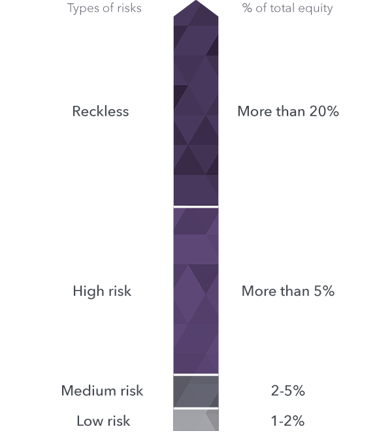
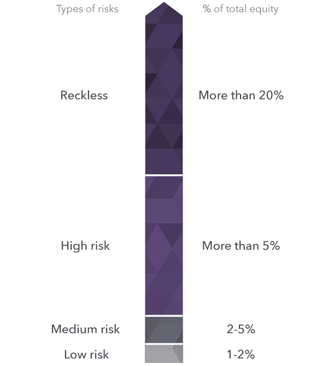
Of course, if you're a long-term investor only making a few select share trades per year, then 10% risk per trade might make complete sense. But if you're a high-frequency forex trader making over a hundred transactions per day, then even 2% per trade could be far too high. It all depends on you and how you like to trade.
Remember, all traders will be affected by a losing streak at some stage, but the ones who plan their trading to cope with those streaks are usually more successful in the long run.
Work out the risk vs reward ratio of every trade
It is possible to lose more times than you win, yet be consistently profitable. It's all down to risk vs reward.
To find the ratio on a particular trade, simply compare the amount of money you're risking to the potential gain. So if your maximum potential loss on a trade is $200 and the maximum potential gain is $600, then the risk vs reward ratio is 1:3.
If, for example, you placed ten trades with this ratio and you were successful on just three of those trades, your profit and loss figures might look like this:
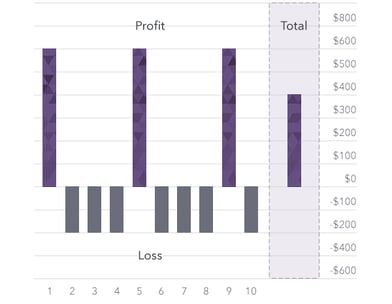
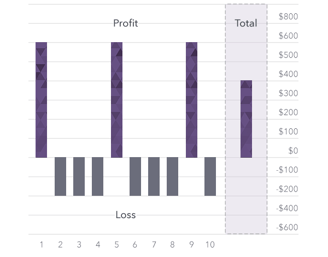
Over ten trades you could have made $400, despite only being right 30% of the time. That's why many traders like to stick to a risk/reward ratio of 1:3 or better.
A word of warning though – if you're taking on less risk for a greater potential reward, it's likely the market will have to move further in your favour to reach your maximum profit, than it will to hit your maximum loss.
So, in the above example, the market would probably have to move three times as far in your favour to reach a $600 profit, than it would have to move against you to cause a $200 loss.